gossip-page | gossip site | celeb gossip | Showbiz
3.26.2019
Disasters
Abstract: Similar to many famous cities in the world, Hong Kong faces various disasters in the video game world. This article goes through all these disasters, including earthquakes, nuclear threat, bio hazard and giant attacks, and discusses how likely we are to see them in the real Hong Kong.
Earthquakes
In the game Illusion City: Gen'ei Toshi (Micro Cabin Corp. MSX turbo R: 1991, FM Towns/MSX/PC-98/Sharp X68000: 1992, Sega CD: 1993), Hong Kong is described to be destroyed overnight in 200X by a mysterious earthquake.
Damage to Hong Kong due to the unexplained crustal movement in Illusion City: Gen'ei Toshi.
Two main causes of earthquakes are faults and volcanoes. Faults are the boundaries of crustal plates. From time to time, the plates are moving towards or sliding again one another, causing earthquakes. Volcanoes are hot liquid from underground known as magma gets ejected, thus they are where the movement of magma is relatively active. The movement results in pressure changes in the rock around where the magma has experienced stress. This may trigger the rock to break or move, thus inducing earthquakes.
The mysterious earthquake in the game was once regarded unexplainable at the beginning because the city is long thought to be free from faults and volcanoes. For faults, Hong Kong lies within the Eurasian Plate and is located rather far away from the nearest boundary with the Pacific Plate on the Circum-Pacific Seismic Belt that runs through its neighboring places Japan, Taiwan and the Philippines. For volcanoes, Hong Kong is indeed sitting above a super volcano. However it has been extinct for more than 140 million years ago.
The tectonic plates of the world. Hong Kong is located on the far left hand side, marked as a star. Source: Wikipedia
As a result, the chance of a major earthquake in real Hong Kong is very small. A recent study done by Geotechnical Engineering Office of the Hong Kong government shows that in the city, the return period for a Mercalli Intensity Scale Intensity V (5) tremor (which is felt by nearly everyone, with some dishes and windows broken, and unstable objects overturned) would be 30 to 40 years and that for an Intensity VII (7) tremor (slight to moderate damage in well-built ordinary structures; considerable damage in poorly built or badly designed structures) would be 500 to 600 years. In fact, the disaster in the game was later known as demon-coming crisis (降魔変) because the city was found to be full of monsters after the event. Earthquake appeared to have been used to disguise some other actual cause of the demolition.
Probably because the chances of earthquakes is rare, private buildings are yet required to meet any specified seismic-resistant design standards. Fortunately, in case of rare earthquakes the buildings are basically safe (despite some possible structural damage) due to the statutory requirement to have them withstand the load from strong wind, usually due to hurricanes (a.k.a. typhoons) that hit the city during summers. What is even luckier is that the extinct volcanoes has not only reduced the chance for Hong Kong to get a major earthquake, but also that left us a valuable geo-treasure. In Hong Kong Global Geopark, you can find gorgeous hexagonal volcanic tuffs due to past seismic activities of the extinct volcanoes.
Hexagonal rock columns near the High Island Reservoir East Dam in Hong Kong Global Geopark. Source: Wikipedia
In the game Bujingai (Taito. PlayStation 2: 2003), it is described that in the future, nuclear fusion reactors are set up on the Moon. Microwave emission satellites are used to transfer the energy from the reactors to Earth. Unfortunately, in AD22XX, the satellite suddenly becomes abnormal. Its high-energy microwave emission destroys 70% of the population and all its governments. Hong Kong is turned to a ruin and then occupied by monsters.
Ruined Hong Kong appeared in stage 1 "Forsaken City" of Bujingai.
Nuclear fusion is a nuclear reaction in which two or more atomic nuclei come very close and then collide at a very high speed and join to form a new nucleus. During the process, huge energy is generated which can be used to boil water to turn turbines and generate electricity. This way to generate heat emits far less greenhouse gas than counterparts burning fossil fuel. However, the fusion process requires an exceptional condition which we have yet fully maintained to make the technology useful in production.
What we know how to do is a close relative of nuclear fusion known as nuclear fission. Nuclear fission is either a nuclear reaction or a radioactive decay process in which the nucleus of an atom splits in smaller parts. Similar to fusion, the fission process often releases a very large amount of energy. The technology is used in all conventional nuclear power plants.
Nuclear fusion (fusing multiple lighter atoms into a large one) vs nuclear fission (splitting a large atom into multiple smaller ones). Source: Prof. Patricia Shapley.
However, the process also generates radioactive wastes. Radioactivity is well known to cause unwanted mutations and cancers to the living beings. If there is an accident, the radioactivity materials may leak to the environment and cause biological disasters. As at 2016, nuclear power accidents have already ruined two places: Chernobyl in Ukraine and Fukushima in Japan. Animals in the affected areas are often reported to suffer from unwanted mutations, and people living there have far higher chances to catch various kinds of cancer than others. People living near the accident site are usually asked to leave immediately. Places so abandoned could take tens or even hundreds of years before the radioactivity is gone and become good to stay again.
Despite the potential danger, Hong Kong is now surrounded by quite a few nuclear power plants. Daya Bay Nuclear Power Plant, which is 50 km away from the city, has been running since 1993 despite strong opposition from Hong Kong people. Ling Ao Nuclear Power Plant which is 60 km north of Hong Kong, 1 km away from Daya Bay was started in 2002. Another one in Yangjiang is in operation starting 2014. The Taishan one, 130 km away from Hong Kong, is scheduled to start operation in 2018.
Nobody wants any more nuclear tragedies. With the nuclear plants as our neighbors, the best that we could do is to make sure the incident notification mechanism is working, keep an eye on the expansions of existing plants and new constructions of new plants, and familiarize ourselves with the evacuation plan. Here I would like to give a special mention of the Hong Kong based news agency Factwire which unveiled potential safety concerns on the Taishan nuclear power plant in 2016, which eventually pressed the power company to disclose more information and took more measures to reassure public confidence on the plant.
Bio hazard
In the game Resident Evil 6 (Capcom. PlayStation 3/Xbox 360/Microsoft Windows: 2012) set in 2010s, some terrorists developed a virus called C-virus. If a human was in touch with the virus, he would be turned to a zombie. A victim of this virus turned out to be the fictitious China's coastal province of Lanshiang (蘭祥) which was modeled after Hong Kong. In June 2013, one of its city called Waiyip was attacked by zombies created by C-virus. On July 1st of the same year, a missile was fired at another city of Lanshiang called Tatchi. Armed with a C-Virus warhead, its detonation released a cloud of the airborne virus across the city, transforming all people there into zombies.
The C-Virus cloud encompassing Tatchi, a city of Lanshiang in Resident Evil 6.
People infected with C-Virus attacking other people in Resident Evil 6.
Bio hazard does exist in real Hong Kong.
A well-known, recurring one is the bird flu. The most noted one started in April 1997, when some chickens in the city were infected with bird flu H5N1. In August of the same year, it was spread to human and led to the death of a 5-year-old boy. Since then, more and more human infections were discovered. 18 cases were confirmed, 6 of whom died. To stop the pandemic, the Hong Kong government took the suggestions of World Health Organization (WHO). To suppress the origin of the virus, all the chickens in the territory were killed, and all the live bird shops were thoroughly cleaned and closed for a period of time. Officials and scientists also worked out a mechanism to monitor the health of live poultry in farms, borders (if imported), wholesale markets and retail stores. Whenever anomaly is detected, the slaughters and cleaning will repeat and this means another period with no live chickens on market.
Selling live chickens in a Hong Kong wet market. Source: SCMP
Live chickens being killed massively during 1997 H5N1 bird flu outbreak. Source: BBC Chinese
However, the most severe bio hazard in recent years was perhaps the 2003 outbreak of Severe Acute Respiratory Syndromes (SARS). The virus first causes flu-like symptoms such as fever, cough and sore throat. The patient may eventually get shortness of breath and/or pneumonia. The SARS epidemic appeared to have started in Guangdong Province, China in November 2002 where the first case was reported that same month. The patient died soon after, and no definite diagnosis was made on his cause of death. Despite taking some action to control it, the mainland Chinese government neither allowed its press to report the cases nor informed the World Health Organization of the outbreak. The minute knowledge the world knew about the situation was that there might be some strange diseases happening in Guangdong. Citizens there were reported to have started doing strange things such as boiling vinegar or taking some specific Chinese medicine called Radix Isatdis (板藍根). The world treated the phenomenon as a tidbit rather than a hint of a serious pandemic.
A coronavirus that may cause SARS. Source: Wikipedia
The disease spread in Hong Kong from a mainland Chinese doctor who arrived in February and stayed on the ninth floor of the Metropole Hotel in Kowloon, infecting 16 of the hotel visitors. Knowing nothing about the new virus at all, the infected visitors traveled to Canada, Singapore, Taiwan and Vietnam, spreading SARS to those locations. Another large cluster of cases in Hong Kong centered on the Amoy Gardens housing estate. Its spread was suspected to have been facilitated by defects in its drainage system. To control the spread inside the housing estate and to the wider community, the government ordered a mandatory evacuation and quarantine for all residents there.
Mandatory evacuation of Amy Gardens residents during 2003 SARS outbreak. Source: now news
The pandemic in Hong Kong went from March to May 2003, causing 1755 infected, 299 dead, including 6 public hospital stuff and 2 private doctors. To the world, it caused 773 deaths.
Salute to those people who stayed professional in their positions during the pandemic!
Attacks by giants
In the game Gamera 2000 (Daiei Digital Entertainment. PlayStation: 1996), aliens are invading the world and Hong Kong turns out to be one of their targets. The 80m-tall giant turtle Gamera joins forces with the Science Defense Academy against the invaders.
The Neo Hong Kong stage, filled in extruding advertising Neon signs, in Gamera 2000
Fighting the giant monster called Gyao 3 (central top) which occupies Neo Hong Kong with the help of Gamera (left) in Gamera 2000
The Gyao 3-Gamera fight illustrated with models. Source: plaza.rakuten.co.jp
Besides the alien attack, there are also giant attacks due to humans ourselves. For example, video games adapting the giant robot anime Mobile Suite Z Gundam often include the fight of the giant robot Psycho Gundam (around 40 m tall) with another robot Gundam Mark-II (around 20 m tall) inside Neo Hong Kong.
Psycho Gundam
Psycho Gundam transformed to mobile fortress mode
The fight between Gundam Mark-II and Psycho Gundam in Hong Kong in Dynasty Warriors: Gundam 2 (Bandai Namco Games. PlayStation 2/PlayStation 3/Xbox 360: 2008)
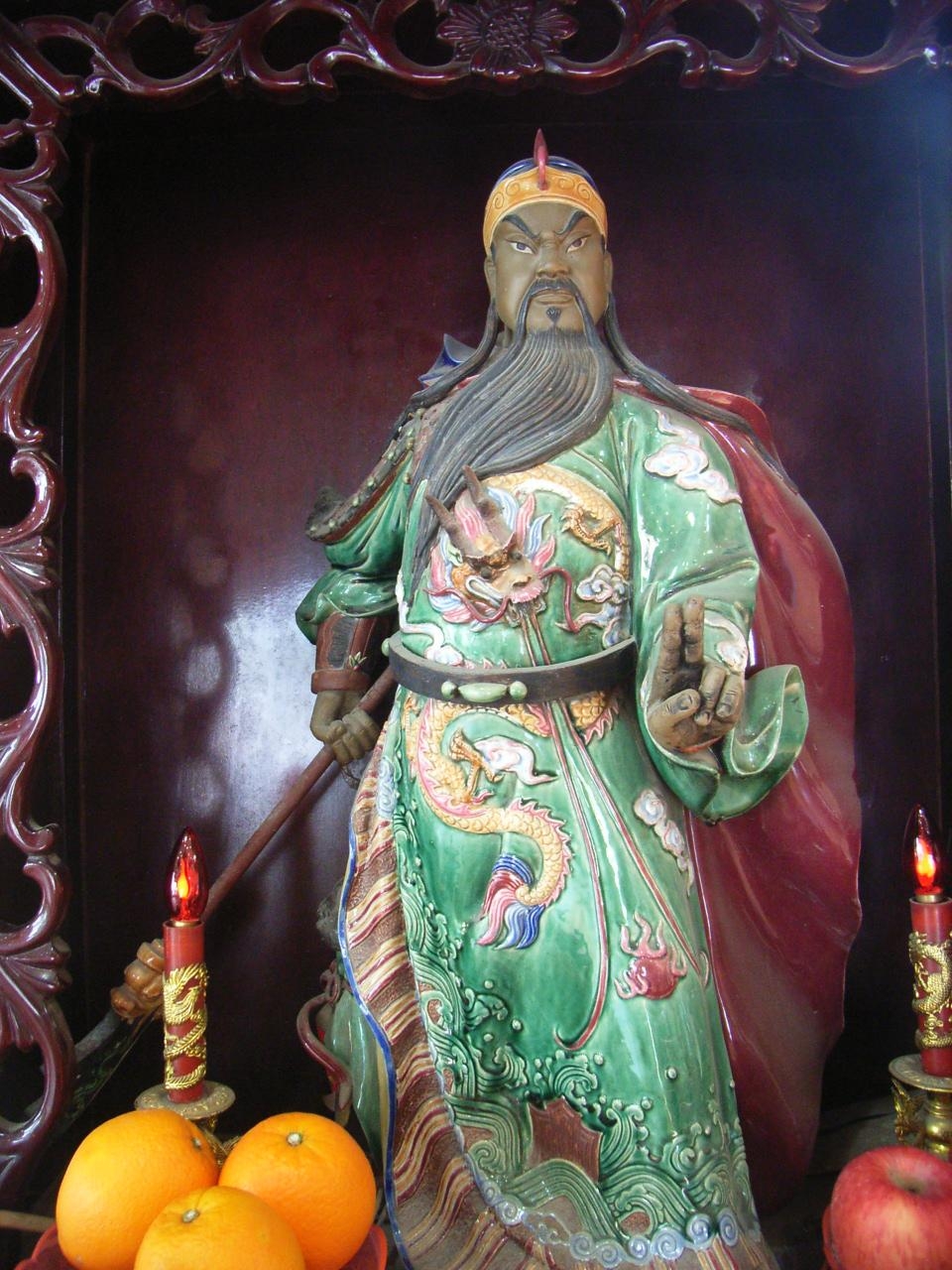
In reality, we (also the people all around the world) are lucky not having seen any of these kinds of giant attacks - we have yet seen reports (or nobody has disclosed one at least) on aliens, and humanoid robots are thought to be way less efficient and practical than other arms such as droids. But if there is really one, would Kwan Yu which is honored by a lot of Hong Kong people (see here for more details) come out to help us just as what he did in the movie The Big Calamity 戰神/香港大災難 (1976)?
Kwan Yu fighting aliens in Hong Kong in the movie The Big Calamity (1976). Note the Hong Kong Hilton and former Legislative Council (now the Court of Final Appeal) in the background.
Final Remarks
After looking at all the above, you should have found that Hong Kong is located at a place which is be normally free from most natural disasters such as earthquakes. Meanwhile, we remain alerted and well-prepared for the worst to come as in nuclear accidents. In the worst case when a disaster really happens, most of us remains professional at our positions to get things fixed as in SARS. Wish this fortune and professionalism continue to be with the city so we never need to bother Kwan Yu to protect us from giants.
An amateur movie describing what might happen if Hong Kong is doomed to be destroyed by a meteorite in 2047